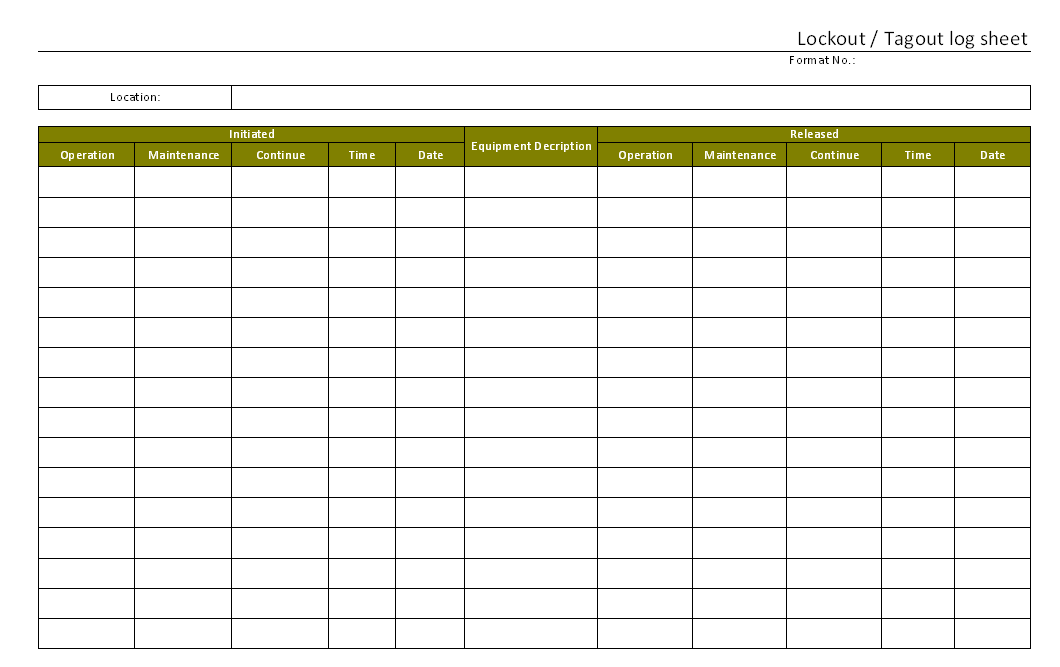
In high-risk industrial environments, a single misstep during equipment maintenance can lead to catastrophic injury—or worse. A technician assumes a machine is de-energized, only to discover too late that someone else restored power. These incidents are preventable. At the heart of that prevention is a simple but critical document: the lock out tag out log.
Lock out tag out (LOTO) logs are more than bureaucratic paperwork—they’re legal, operational, and safety lifelines. When used correctly, they provide a clear audit trail of who locked what, when, and why. When ignored or poorly managed, they become liability traps.
This article cuts through the noise. You’ll learn how LOTO logs function in real-world operations, where most companies fail, and how to build a logging system that actually works under pressure.
What Is a Lock Out Tag Out Log?
A lock out tag out log is a formal record of energy control procedures applied to machinery or equipment during servicing or maintenance. It documents each step of the LOTO process, including:
- The date and time of shutdown
- Name and ID of the authorized employee
- Equipment involved
- Type of energy isolated (electrical, hydraulic, pneumatic, etc.)
- Lock and tag numbers used
- Verification of zero energy
- Time of re-energization
Unlike a one-time tag, the log is a dynamic record—often maintained digitally or in a physical binder—accessible to supervisors, safety officers, and maintenance teams.
Think of it as the “flight data recorder” for maintenance events. If something goes wrong, the log tells you exactly who did what and when.
Why LOTO Logs Are Non-Negotiable
OSHA’s standard 29 CFR 1910.147 mandates that employers implement a written energy control program. That includes documentation—and logs are the backbone of compliance.
But compliance isn’t the only driver. Real operational value comes from:
#### 1. Accountability During Shift Changes Maintenance often spans shifts. Without a log, a night technician might unknowingly re-energize equipment another team is still working on. A properly updated LOTO log ensures continuity and prevents deadly assumptions.
#### 2. Audit Readiness During OSHA inspections, logs are among the first documents requested. Companies with incomplete, missing, or falsified logs face steep fines—often exceeding $10,000 per violation.
#### 3. Incident Investigation When an accident occurs, investigators rely on logs to reconstruct the timeline. Was the lock applied? Was energy verified? Was the log signed off prematurely? These answers determine fault and guide corrective action.
#### 4. Training and Process Improvement Trends in the log—frequent lockouts on one machine, recurring delays in de-energization—highlight maintenance bottlenecks or training gaps.
Common Mistakes That Undermine LOTO Logs
Even companies with strong safety cultures make critical errors. Here are the most damaging:

#### Using Generic or Blank Logs Many teams use a one-size-fits-all template that doesn’t reflect equipment-specific hazards. A log for a conveyor belt shouldn’t look the same as one for a pressurized boiler. Lack of specificity leads to skipped steps.
#### Failing to Update in Real Time A technician locks a machine at 8:00 AM but doesn’t log it until 10:00 AM. That two-hour gap creates a blind spot. Logs must be completed before work begins.
#### Allowing Unsigned or Unverified Entries Digital convenience has led to shared logins or auto-filled fields. But OSHA requires individual accountability. If a log isn’t signed by the authorized employee, it’s invalid.
#### Ignoring the “Group Lockout” Complexity When multiple workers service one machine, a group lockout log is required. Yet many teams use individual logs, creating confusion about who has control. The primary authorized employee must maintain a master log listing all participants and their locks.
#### Storing Logs in Inaccessible Locations A log saved on a single laptop or buried in a filing cabinet defeats its purpose. It should be visible at the equipment site or accessible via mobile devices in real time.
Best Practices for Effective LOTO Logging
To turn your LOTO logs from a compliance checkbox into a safety tool, follow these field-tested practices:
#### Use Equipment-Specific Templates Create unique log templates for high-risk or complex machinery. Include pre-defined energy sources, isolation points, and verification steps. For example:
| Equipment | Energy Sources | Isolation Points | Verification Method |
|---|---|---|---|
| Hydraulic Press | Hydraulic, Electrical | Valve shut-off, Circuit breaker | Pressure gauge, Voltage tester |
#### Mandate Real-Time Logging Require entries to be made on-site, immediately after applying each lock. Use mobile apps or wall-mounted kiosks near machines to reduce friction.
- #### Implement a Sign-Off Chain No re-energization until:
- Work is complete
- Tools are removed
- The log is reviewed and signed by the original lock applicator
- Supervision verifies clearance
#### Conduct Monthly Log Audits Assign safety officers to audit 10–20% of logs monthly. Look for: - Missing verification steps - Inconsistent timestamps - Duplicate or missing signatures - Equipment not listed in the master inventory
Use findings to refine training.
#### Train on What a Log Really Means Too often, employees see logging as a formality. Drill into teams that the log is their personal contract with safety. If they skip a step, they’re not just violating policy—they’re risking their life.
Digital vs. Paper LOTO Logs: What Works Best?
The debate isn’t about technology—it’s about reliability under stress.
#### Paper Logs: Pros and Cons Pros: - No reliance on Wi-Fi or power - Simple to use with minimal training - Hard to alter without visible traces
Cons: - Prone to loss, damage, or illegible handwriting - Difficult to search or audit at scale - No real-time alerts or integration with work orders
Best for: Small facilities with low maintenance volume and stable teams.

#### Digital Logs: Pros and Cons Pros: - Instant access from any device - Auto-populate equipment details and energy types - Flag incomplete entries before submission - Generate compliance reports with one click
Cons: - Requires initial setup and training - Dependent on system uptime - Risk of over-automation leading to complacency
Best for: Mid to large operations, multi-site companies, or those under frequent audit scrutiny.
Hybrid systems—where digital logs are backed by printed summaries at equipment sites—offer a balanced approach.
5 Tools That Improve LOTO Log Management
While no software replaces human diligence, these platforms streamline logging, tracking, and compliance:
- Enablon (by Industrial Scientific)
- Enterprise EHS platform with dynamic LOTO workflows, mobile logging, and real-time dashboards. Ideal for large manufacturers.
- iAuditor by SafetyCulture
- Customizable checklists and LOTO logs with photo documentation and offline access. Popular in food processing and logistics.
- Proteus EQMS
- Integrates LOTO logs with maintenance management (CMMS), ensuring lockout steps appear in work orders.
- LockOut/TagOut Buddy
- Affordable mobile app for small teams. Features lock tracking, log history, and OSHA checklist templates.
- SpheraCloud Operational Risk
- Advanced analytics for LOTO trends, predictive risk scoring, and audit trail export.
Choose tools that sync with your existing safety ecosystem—not just ones with flashy interfaces.
Real-World Example: How a LOTO Log Prevented a Fatality
At a Midwest auto parts plant, a technician began servicing a robotic arm. The LOTO log showed two locks applied—one by him, one by a colleague on an earlier shift. Before starting, he double-checked the log and noticed the second lock hadn’t been removed, but the log wasn’t signed off.
He investigated. The other technician had completed work but forgot to update the log. The machine was still under lock, but the oversight could have led to a premature release.
Because the log was accurate and accessible, a potential disaster was avoided. The company later reinforced mandatory log updates as part of its safety culture campaign.
Building a Culture Where LOTO Logs Are Respected
Technology and templates aren’t enough. The most effective LOTO programs treat logs as sacred documents.
How? - Include log reviews in pre-shift meetings - Recognize employees who catch errors in logs - Display anonymized log mistakes (without blame) in training - Tie safety bonuses to log accuracy, not just incident counts
When workers understand that the log protects them, not just the company, compliance becomes instinctive.
LOTO logs are not paperwork. They are proof—proof that energy was controlled, work was verified, and people went home safe. Treat them with the seriousness they deserve. Audit them monthly. Train on them relentlessly. And never let convenience override protocol. In safety, the smallest detail in a log can be the difference between a routine repair and a permanent injury. Make every entry count.
FAQ
What should you look for in Lock Out Tag Out Logs: Why They Matter and How to Use Them? Focus on relevance, practical value, and how well the solution matches real user intent.
Is Lock Out Tag Out Logs: Why They Matter and How to Use Them suitable for beginners? That depends on the workflow, but a clear step-by-step approach usually makes it easier to start.
How do you compare options around Lock Out Tag Out Logs: Why They Matter and How to Use Them? Compare features, trust signals, limitations, pricing, and ease of implementation.
What mistakes should you avoid? Avoid generic choices, weak validation, and decisions based only on marketing claims.
What is the next best step? Shortlist the most relevant options, validate them quickly, and refine from real-world results.